
THE GIANT OUT OF (HIS) TIME
I first saw him in Cottbus, 2019. I can’t even say if it was spring or autumn, because some days in Germany all seem the same. Gray, swollen with tension and still air. The track is the one you know: concrete, wide bends, sharp edges in your eyes, and cyclists nervous as coiled springs. I’m there with two very young lads, Leo and Mattia, and the ambitious Francesca. They were fighting for their place in the world. He, Jan-Willem, already had the rainbow jersey on his back.
Points race World Champion. .
The world championship was held in Pruszków in March; the rainbow jerseys are still fresh, and the level in Cottbus is always high.
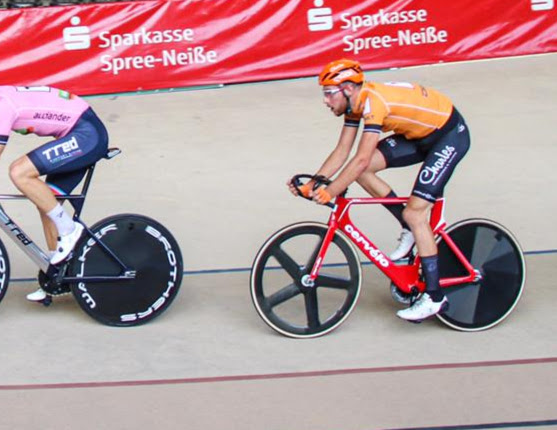
In Poland, he’d racked up points, nullifying the ambitions of an aggressive Sebastian Mora. Points races are like that; you win them against someone, not against the group. One hundred and sixty laps of a world championship are too many for anyone, and you pretty much know right away who the three or four medal contenders will be. And once it was clear Jan was one of them, the game got really tough for the others.
But it’s not just the jersey. It’s how he wears it. As if it weighs him down. As if he knows that more than a crown, it’s an invitation to war. And indeed, when the race starts, I immediately realize something’s off. His teammates – yes, his – are racing against him. They don’t help him, don’t protect him. They get in front of him, mark him, attack, complicate every lap for him. It seems the “orange” riders have the sole purpose of making the orange rider in the striped jersey lose.
And him? Nothing. Head down, eyes fixed, legs grinding like an overloaded nuclear power plant. Balls as big as hot air balloons and his own unique way of being in the saddle. He’s on a red Cervélo, too small for him. He looks like a giraffe on a tricycle. Ridiculous and devastating at the same time. A biomechanical paradox that nonetheless works. In fact: it kills.
He destroys the race. I don’t even know if he won, but he decided everything. As always. Jan-Willem isn’t one to wait for something to happen. He’s one who makes it happen. Even if it’s not convenient. Even if no one applauds him. What impresses me most is seeing how, with ill-concealed anger, he still closes down on everyone. I think in his head, a “but why are they doing this” was echoing, but on the other hand, if you’re a racer, a real racer, you race to win, to beat your opponents. And if the world champion wears your same colors, too bad. He’ll be the first one you want to beat.
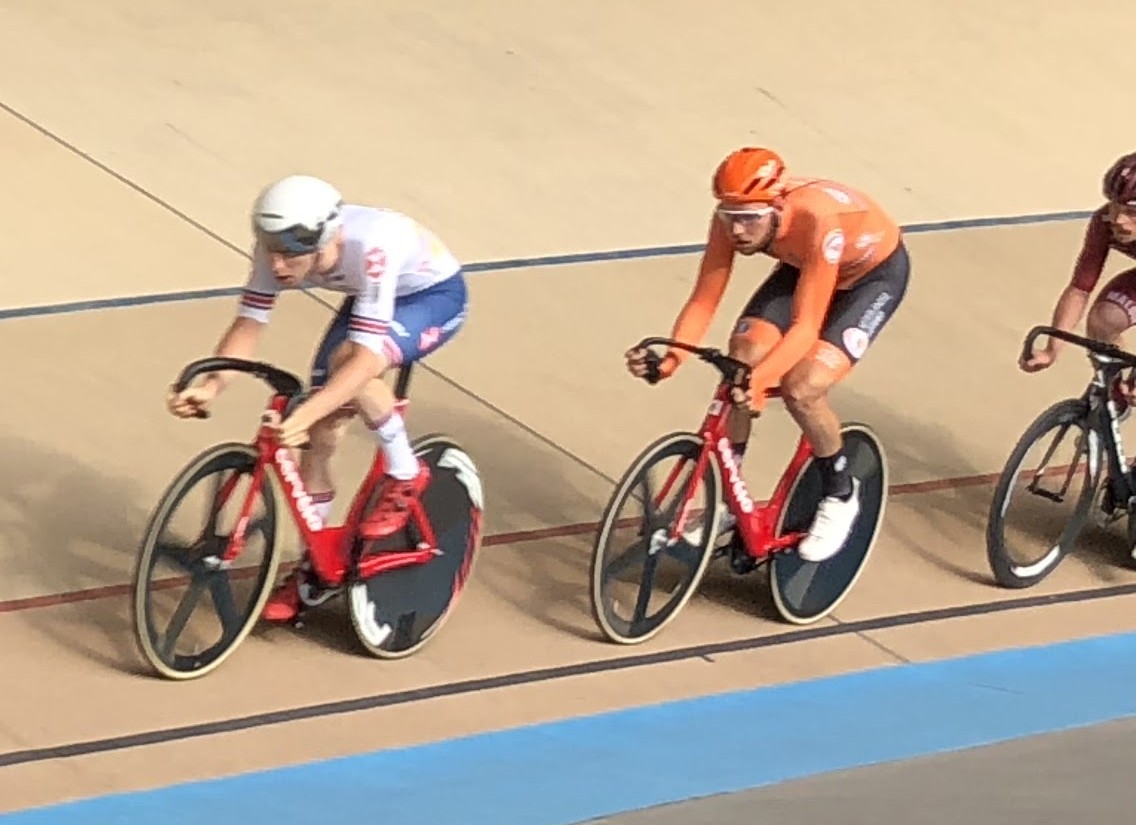
Over the years, we found each other. We built strange handlebars, borderline positions, controversial geometries. We questioned everything, even the unwritten rules. Because Jan-Willem is one who asks questions. Not to seem brilliant. But because he wants to know. He wants to go faster. He wants to dig. He wants to dismantle the bike like you dismantle a life: piece by piece, until you understand where the truth is hidden.
And while many talk about performance as if it were an advertising concept, with beautiful photos of gravel bikes in wind tunnels, he lives performance inside, under his skin. With cramps, with depression, with doubts, with anger. And also with a rare, lucid, ruthless clarity, which one day he decided to put down in black and white for me.
When I sent him the Manifesto, I knew Jan-Willem would understand. Not immediately, perhaps. But he would feel it.
He replies after a few days. A dry, direct message, just like him. “I really like what you’re doing.”
And then he underlines that very sentence, the one about musicians, the one I had feared was too much—too personal, too unbalanced: “But just as it was difficult for Chuck Berry, Jimi Hendrix, David Bowie, and Massive Attack, it is difficult for us too.”
“I like that you feel the effort,” he writes. “It cost me energy too. And communicating with the UCI is damn complicated.” Then he disappeared. Not figuratively. “For now, I’m out of that subject. I’m in it up to my neck for the Olympics. That’s where my focus is.”
“I’m curious about the data on the Koga and the other bikes you collected in Valencia. Until the Olympics, we’re obliged to use that one. I can’t change.
But after…
After, we’ll be free. Free to go beyond.”
The text he sends me after the Olympics, without even a warning, I don’t touch it. I let it speak for itself. Because it’s his voice. And it’s right that it should be so:
“When do we perform?
What is the goal?
What is the feeling?
Why are you here, what are you doing?
What is the most important?
What is the worst that can happen?
As I found out, performance can be used as a tool for different reasons. Not everyone is in the same game for the same reason. Most likely they are there for different ones. It took me a very long time to figure that out. Someone can be in a race, to numb their feelings, to feel their feelings, to feel belonged to a group, to satisfy someone else or because it’s scarier to do something else.
My goal, my dream, my reason, my performance. Is winning. To end up on the highest step of the podium. To find a better combination than my competitors, I like to puzzle.
I don’t care about how it looks, I just wanna know if it is faster. I want to test, to be honest. If we change this, does it get better? People wanna improve but they do not want to measure if they are actually right. They are ashamed if they lose. I see losing as fuel. You do the accountancy of it. You add and subtract. Till there is more energy in your tank.
The magic of a race-decisive-moment, where you are the one making it. Because your tank is fuller than the others. That’s the ultimate play.
What are the right cues to improve? I think it works like a navigation system. It can give you a cue, go right in 200 meters. But it will only work if it knows where you are. And if you know where you want to go. We all dream, we all wanna win double gold at olympics, that’s not so difficult. It gets difficult when you have to accept where you are. That is the sport of performance. Somehow I like this honest painful clarification of my location. Because after it, I know I’m going forward. This location determination is the key to perform. The mindset, and trust in yourself to accept where you are, that is the mindset.
It’s a mindset you have to protect. The biggest enemy of performance is fear, social fear. People disagree about what you do, afraid to get a different opinion. But do they judge you? Or are they afraid to feel where they are themselves? Are they afraid to feel different? It confuses me to see people race to be the outstanding one, but only within the social rules.
I get energised to see the total overview. I don’t care about any social rules. I just want to get more energy in my tank. no matter what. I take my tank, and look. look everywhere. Ask every question. What can be better? How do we go faster? What did you do? Did it get better by using this strategy? What did you test? What do the numbers say? Which parts of the puzzle did you investigate? I don’t care which department I have to look at, whether it is in food, mental, social, temperature or engineering or something else. I like to ask, to learn, to explore, to grow, to get faster, to puzzle better, to decide racing, to enjoy winning.
Ask where am I?
Ask where do I want to go?
Be proud to ask
Be proud to not know
to puzzle more energy in your tank
to decide racing
to enjoy Winning
to perform“.
The first real chat I had with Jan-Willem wasn’t in front of a stopwatch or a flow diagram. It happened in a neutral zone: the after-party of the Six Days of Ballerup, 2019. A lukewarm beer in hand, some poorly heated sausages hastily grabbed from the poor waiter-cook-barman I and Andreas Graf were harassing, bodies still tired and adrenaline refusing to leave. Jan is there, tall as a lamppost, white t-shirt with an absurd drawing on it. Three vertical figures. They look like bottles. Or people. Or columns. I look at him and blurt out: “JW, what the fuck does that shirt mean? It looks like the facade of a church. Three naves, two lower, one central.”
He looks at me. Smiles faintly. “Yeah, it looks like a church.”
And that’s it. No explanation. No theory. Just that answer. Left hanging there. Like a symbol. And deep down, he was right: it was a church. His. And it was for me too. Because from that moment on, every time I met him, we spoke in that language: a language made of oblique references, mechanical obsessions, strange questions, and banging our heads against walls.
In the landscape of modern cycling, few athletes embody the essence of innovation and vulnerability like Jan-Willem van Schip. He’s one meter ninety-four, wears glasses straight out of the early eighties, probably picked up at a flea market in Boxhagener Platz, and has an Instagram profile that reveals his humanity without any arrogance, no celebration, a few selfies, the victories he cares most about, and little else. He isn’t simply a versatile athlete, but a man navigating the turbulent waves of success and suffering with a breathtaking transparency. What’s astonishing is that he moves on the bicycle with a grace that contradicts his imposing stature.
Van Schip begins his professional career in 2014 with the KOGA CYCLING TEAM. Like a cycling nomad, he moves from one team to another, searching for his place in a world that struggles to understand his uniqueness. Delta Cycling Rotterdam, Roompot Nederlandse Loterij, Roompot Charles – each jersey is a temporary stop on his journey towards fulfillment. He is currently with Parkhotel Valkenburg, another stage in his perpetual movement.
On the road, van Schip accumulates significant successes that testify to his raw talent. 2016 is a revelatory year: he wins a stage at the Tour of Mersin, the Grote Prijs Marcel Kint, and a leg of the Olympia’s Tour. But it’s in 2017 that his name begins to resonate more strongly on European circuits. Victory at the Ronde van Drenthe and stage wins in the Tour de Normandie, An Post Ras, and Tour of South Bohemia paint the portrait of an athlete on the rise.
2018 brings triumph in the Slag om Norg, while in 2019 he wins a stage of the Tour of Belgium, further raising his profile among professionals. But it’s on the track that van Schip finds his true dimension, a natural habitat where his peculiarity becomes an invaluable advantage.
Van Schip is not just an exceptional athlete, but an innovator who constantly challenges cycling conventions. He develops a unique cycling position, using narrower handlebars than standard and adopting a grip that becomes his distinctive signature.
This technical peculiarity profoundly marks his career, generating as much admiration as resistance. In 2019, while negotiating with Team Corendon-Circus, bicycle supplier Canyon opposes his signing precisely because of the particular brake and handlebar configuration, deemed too similar to gravel bikes. The industry’s obtuseness is sometimes measured by its inability to read beyond the obvious, and this terribly bothers JW.
He doesn’t digest the dynamics of road team cycling, and in 2019, the year of his world championship in Pruszków, the combination of road and track cycling becomes an unbearable burden: “Combining both disciplines is intensive. Too intensive, I know that now.”
The precariousness of road cycling contracts aggravates his fragile mental state: “I always found it fucking difficult never to get a long-term contract anywhere, except with Roompot. I was strong, I could pull at the front for an entire stage, I just wanted to know how strong I could be.” According to Van Schip, road cycling “isn’t safe,” referring to the constant pressure for performance due to the scarcity of contracts.
When Roompot-Charles closes in 2019, van Schip fails to find a professional team despite good performances and the world champion jersey won on the track. He later signs with BEAT Cycling Club, but exclusion from the professional world wounds him deeply.
“I find it difficult, because I think I deserve it and I should definitely be able to do it, but I can’t,” he confesses in a 2019 interview. “I can go strong and I can stay at the front all day. I don’t feel like just a track rider; I can do well in a classic too.”
Van Schip pays a high price for his authenticity. His genuine personality and vulnerability make him an easy target in the competitive world of professional cycling.
“You just see me for who I am. With all my soul and bliss,” he states. “The only downside is that being vulnerable and honest with yourself causes problems for others. If I’m honest and I show it without hiding it, without filters, there are people who don’t understand, maybe they get scared, run away, and then suddenly they have a problem with me.”
“Once on Vive le Vélo, they laughed a lot about my cut and re-welded stem and my custom aero handlebars,” van Schip recalls with a hint of bitterness. “It’s been proven to work, but no one ever came to me and asked: can I try that too?”
In 2020, van Schip takes his aerodynamic research to a higher level, launching an innovative handlebar in collaboration with a Dutch company, a spin-off from Eindhoven University. His vision is crystal clear: “The idea is actually very simple: you want to go as fast as possible from A to B. So the question is, how do you do it? What is the most determining factor for this? That’s aerodynamics, and you want to influence it. An optimal position can make a difference of 20-30 watts.”
On the track, van Schip transforms his anomalous body into an instrument of precision. In 2019, he wins the world title in the points race, a triumph that consecrates his unique talent. Before this achievement, at the 2018 World Championships in Apeldoorn, he had already demonstrated his class with two silver medals in the points race and the omnium.
2020 sees him on the podium again at the Berlin World Championships, with another silver in the omnium. But it’s in 2021 that he forges a partnership destined to leave its mark: together with Yoeri Havik, he wins the European title in the Madison, a prelude to their 2023 masterpiece, when they become world champions in the same specialty.
Van Schip’s palmarès is enriched with victories in World Cup events and prestigious competitions like the Six Days of Rotterdam and the Six Days of Berlin. In 2023, the Van Schip-Havik pair overcomes Belgian rivals De Vylder and Hesters in the Six Days of Rotterdam, confirming their supremacy in the event.
But van Schip’s innovations don’t always find fertile ground in the conservative world of cycling. In 2021, he is expelled from the Tour of Belgium for using handlebars considered irregular, an episode that highlights the tension between his pioneering spirit and the rigid rules of road cycling.
Behind the mask of the innovative champion, van Schip fights a silent battle against inner demons. In October 2023, in an interview with the newspaper Trouw, he reveals with surprising frankness his struggle with depression, which has afflicted him for a long time.
“Do you know how far I went?” he confesses. “‘If I get a good run-up here and jump far enough, it should be enough to end it completely. With everything.’ I didn’t want to exist anymore. This is who I am. It’s 2023, I’ve been working on it full-time for two and a half years. I appreciate being able to say that sometimes life just isn’t that fun. Many aspects simply suck.”
He says it just like that, without effect. As if he were talking about a Shimano gear change.
But you understand it’s true. You understand because you’ve seen it too, on certain evenings after races, when he talked to you about sensations and balance, and he had that look of a fragile giant who no longer trusts anyone.
Talking to a psychologist helps van Schip accept his diversity. “I also notice now that I can communicate more normally, that I can engage people, and that it’s also allowed for things to be different,” he reflects.
To confront his demons, van Schip undertakes a therapeutic journey he is not at all ashamed of. In the end, he makes the drastic decision to retire from road cycling to focus exclusively on track competitions, an environment where he feels more comfortable.
In recent years, van Schip has become more aware of his behavior and its consequences on those around him, but this awareness aggravates his mental distress. “Sometimes I can come across as a know-it-all, but I also find it difficult to make these decisions. If someone makes a different choice, it has an impact on the whole group,” he reflects.
“Imagine going to a nightclub and everyone is dancing happily, but there’s one person who keeps looking around uncertainly to see if they’re dancing correctly. You definitely make everyone uncomfortable. That guy was me,” he confesses with disarming honesty. As he himself points out: “I want to show that even those who are ‘different’ can win.”
Jan is one who watches. Watches everything. Not because he’s suspicious. Because he’s searching. At races, he’d pass by our bikes, wheels, handlebars. He never asked “what is it?” but “why did you do it like that?”. He had just ditched Cervélo for Koga, after the national team’s sponsor change. But that bike wasn’t his. It was designed for people like Lavreysen: compact, explosive, with a low front end that crushes power onto the pedal. Not Jan. Jan is long. Immense. And to adapt, he did the simplest, most absurd thing: he raised everything. Shims upon shims under the steerer, until the bike looked like a vertical extension of his collarbones.
But raising means shortening. Trigonometry is unforgiving. If you go up at the front, you shorten at the back. And so… longer stems. Very long. So long they didn’t exist. And so what does he do? He takes two aluminum stems, saws them, welds them together. Frankenstein stem. He builds it himself. Because he doesn’t care if it exists. He cares if it works.
The partnership with Yoeri Havik represents a lifeline for van Schip. Together, they find a balance that allows van Schip’s talent to flourish in a supportive environment.
“We found the perfect combination between what we allow him and what we don’t,” Havik states after their 2023 Madison world victory. “I’m so proud of him.”
The track, in all this, becomes his refuge. The only place where he can exist on his own terms. There, no one asks you to be likable. You just have to be faster. More precise. More resilient. And if you can team up with someone like Yoeri Havik, then maybe you can even breathe again.
The Madison title won in Glasgow with Havik represents not only a sporting triumph but also a personal redemption for van Schip. “It’s really beautiful. So, as you see, sport keeps you off the streets. It gives me peace again,” he concludes. It’s one of the most beautiful victories of his career. Not for the title. But because it’s confirmation that there can still be a place even for those like him.
Those who don’t dance like everyone else. Those who look around in nightclubs and feel wrong. Those who ask questions, instead of smiling and saying yes.
Jan-Willem is like that. Someone who searches. Who tests. Who asks. Who makes mistakes. But who never stops wanting to be real. And fast.
The first thing you learn, if you deal with Jan-Willem, is that he doesn’t care how he looks. He doesn’t wonder if he’s elegant, if he’s orthodox, if his bike looks like it’s for the road, the track, or a carnival. He only wonders one thing: “Is it faster?”
That’s why he built himself an absurd position, with narrow handlebars that looked like they came off a child’s bicycle and a stem so short that biomechanics experts would have cried. But not him. He looks at watts. He looks at numbers. And if those absurdities make him 20 watts stronger, then that’s the right choice. Even if it makes people laugh on TV. Even if you get disqualified from a race. For an irregular position. Irregular. What an absurd word, in the world of performance. As if there were a “regular” way to win.
Jan-Willem has a mind that works like a laboratory. Test, measure, change. Once, a sponsor asked him if he could change his position because “it wasn’t nice to look at.” He replied: “I don’t race for photos.”
The truth is, Jan-Willem is an innovator. But not one of the trendy ones. One who innovates because he can’t help it. Because he needs to understand. And because what’s available isn’t enough for him. Ever.
When he feels lost – and it happens often – he looks up and asks: “What would Obree do?” Some are inspired by champions. Not him. He’s inspired by a madman. By a cyclist who built his own bike. Who took bearings from a washing machine and stuck them inside a creature called Old Faithful. Someone who tried to take his own life multiple times. Someone who pedaled to save himself.
Jan-Willem understands him. Feels him. Because that struggle – not to win, but to be – he knows it. It gets stuck between his shoulder blades when he sleeps.
He doesn’t even know everything about Obree. But it’s not necessary. What’s enough is in one sentence: “He tried to end it all, then he became world champion.” End of story. Or maybe the beginning.
There was a day when he was first after three events in the Omnium. Then he collapsed. On the track and in front of a camera. He talked, cried, confessed too much. No one ever aired that interview. But he has it. He shows it sometimes. And others’ reactions always remind him of the same message: “It’s good to show vulnerability… but only up to a certain point.”
They call him a know-it-all. They call him difficult. They attack him. When he races with handlebars too narrow, they insult him. When he develops a custom cockpit, they laugh. When he cuts a twenty-centimeter stem, they ask if he can still turn.
His gaze, always, goes towards that photo of the “Flying Scotsman” on the wall of his flat.
“He didn’t want to be the washing machine guy. He just wanted to go faster. And instead, everyone only remembers him like that. As if that story were enough to contain everything.”
Even Jan-Willem, perhaps, will be remembered as the strange one, the one who talked too much, who tried things that shouldn’t be tried. But meanwhile, he dreams of two Olympic golds. Meanwhile, he builds solutions. Meanwhile, he continues to search for new paths, and certainly not for fashion.
Because that’s how he survives. Because for people like him, like Graeme, like us… performance isn’t a goal. It’s an obsession. It’s a way to stay alive.
One evening near Christmas, he writes to me on Instagram because he wants to try ASHAA but… for the road. We chat about bullshit, music, how boring the cycling world can sometimes be, but the focus is clear. Do better.
I explain my idea about stack and reach of the hands in the position he wants to achieve, and I propose a challenge to complete together, but I need his feedback.
I print an extreme version of ASHAA in steel for him; Ferdinando and Gianluca optimize it to try to achieve the stiffness and weight we want, but the design must be an adaptive starting point.
He has two stems for his Giant cut and welded together to make a longer one, and he flips it for a positive rise—the kind of setup that will get you ridiculed by amateurs for months.
Jan-Willem doesn’t care; the team supports him, and he starts experimenting and riding fast. This thing about getting strong on the road again is gripping him, and I like being part of it. I send him videos of the models I’m working on, he asks me questions; he’s more than a winning athlete.
But there comes a precise moment in an athlete’s life when they realize they are no longer simply an athlete. It happens suddenly, yet you’ve felt the first signs for some time. It’s when every gesture you make ceases to be a personal choice and becomes something more: a symbol, a provocation, a threat.
For Jan-Willem Van Schip, that moment takes shape on June 1, 2024, during the Heistse Pijl, a seemingly ordinary race, nestled among the more prestigious events of the Belgian cycling calendar. The air that morning is different, charged with a silent anticipation. Everyone knows something special is about to happen.
Jan is on the starting grid, his dark bicycle beside him, wrapped in his usual silence. But today, there’s something different. In his hands, he holds the Ashaa handlebar – narrow, sharp, uncompromising. He’s not trying to make a statement; he simply wants to go faster.
His racing position is radical, but calculated with surgical precision. Every angle, every curve has been studied, verified, perfected. For the race commissaires, however, only one detail matters: his forearms are resting in what they consider an illegal position – the infamous “puppy paws” banned by the UCI since 2021.
The warnings come. One, two, three. Jan doesn’t move. Not out of arrogance, but pure conviction. If this position makes him more stable, safer, more performant – then it makes sense. And if it makes sense, you adopt it.
He crosses the finish line 66th and then disappears, disqualified. No official note, no direct explanation – just a silent deletion from the classification, like erasing an extra line in an Excel sheet. But everyone knows. Everyone was waiting for this moment.
Escape Collective tries to report the incident with professional detachment, discussing regulations and gray areas. But it avoids the uncomfortable truth: Jan is punished because he’s uncomfortable. Because he thinks too much. Because he asks too many questions. Because he refuses to just look aerodynamic and instead tries to be aerodynamic.
There’s talk of a possible infringement of Art. 1.3.008: irregular position. Someone cites Art. 2.2.025: dangerous behavior. And then the infamous 2.12.007, point 7.9: “use of a non-compliant position or point of support that represents a danger.” But the problem isn’t just technical; the problem is aesthetic. Ideological. Political. Van Schip didn’t violate the rule out of ignorance; he challenged it out of coherence, and this is the real scandal.
Not the forearm on the handlebar, but the conscious will to find a faster position. The ability to question a norm, not for convenience, but for evolution. Like his myth, Graeme Obree.
And as if that weren’t enough, on June 1st – the same day as his disqualification – Felix Ritzinger wins a stage of the Tour of Malopolska with the same handlebar. But Felix’s attitude with the jury is more accommodating: rock, not quite punk, you see.
Felix wins, Jan disappears. Same equipment, two opposite destinies. Coincidence? Perhaps. Or perhaps it’s the system, or those who administer it, that, once again, doesn’t know how to manage innovation except by punishing it.
Then comes the social media ambush. “Cycling for Cycling” publishes a slow-motion video – footage that seems to want to explain but is actually designed to destroy. The message is clear and petty: Jan isn’t just breaking rules; he’s dismantling a system that demands order, silence, uniformity.
His response is brutal in its simplicity:
“Fucking nice smooth aero gangster shit. Use your brain. Go fast. ❤️” JWVS.
No defense. No polemic. Just truth. A punk gesture delivered with the precision of someone who makes you believe they have a master’s in aerospace engineering.
Use your brain. Makes you think, doesn’t it?
A few days later, at the Mirabelle, wearing the Dutch national jersey, Jan embodies the spirit of someone with nothing left to lose. In the final kilometers, he’s not just racing – he’s deciding. In the first stage, he seems like a reincarnation of himself. Lucid, ferocious, perfectly embedded within the bike. When the final kilometer starts, he’s already there.
He doesn’t react. He decides and launches into a sprint that isn’t made for him.
And he finishes second. I have a photo seared in my mind, taken by I don’t know who, just after the finish. Jan-Willem is sitting on a park bench near the finish line, alone, exhausted. He knows it wasn’t his duty to win that sprint; it would have been nice, right perhaps.
But the miracle is that he stays there, in his head that isn’t capable of giving up, and in the toughest stages, on the most bastardly climbs, you see him clench his jaw, bend over, disappear into the group… and then re-emerge, not because he has climber’s legs, but because he decided he would be there. Until the end.
In the end, he’s second in the general classification, but above all, he wins the most combative rider’s jersey.
And there’s no more fitting prize because if there’s one rider who has made struggle a form of design, it’s him: every stage is a lesson, every curve an experiment, every second gained the result of a test, a gamble, a micro-revision in the geometry of himself, of his efficiency, of his performance.
If there’s one cyclist who has transformed struggle into a form of design, it’s Jan-Willem Van Schip. Every stage is a lesson, every curve an experiment, every second gained the result of a test, a gamble, a geometric micro-revision.
He didn’t just race. He challenged. He redesigned. He flew.
In 2024, van Schip’s career is still marked by highs and lows. At the Paris Olympics, he delivers a gratuitous headbutt, due to carelessness, fatigue, frustration, to Oliver Wood during the Madison race, causing an accident and his immediate disqualification. But anyone who knows Jan-Willem knows he didn’t arrive in Paris calm. He arrives empty. Out of gas. Without anger. Without faith. Jan-Willem van Schip hasn’t lost the will to win. He’s lost the will to pretend. Because before the track, before the jersey, before the bike, there were weeks of silence. Of uncomprehended choices. Of averted gazes and unexplained benches. He’s won world titles, he’s invented shapes for his body to go faster that no one sees, he’s built his own tools like Obree built his bikes. But when it came to choosing, someone else decided for him.
They had left him out, then in, then in doubt again. They had accepted him on the condition that he adapt. But JW isn’t one to adapt. He’s one who designs the world his own way. And when you force him to shrink the design into a frame, only one thing comes out: frustration.
Ballerup. The elimination race: World Championships 2024. The chance to redeem himself. But you don’t climb out of an abyss with a number on your back. You climb out with a why. And he, that why, has lost it somewhere between a coach who doesn’t call, a teammate, a friend who doesn’t answer, a group that looks at you like you’re a problem, not a resource. He races. Does his thing. Makes no mistakes. But around him, everything goes wrong. The plan, the strategy, others’ legs. They get down to a small group, his legs are turning over well.
Jan-Willem van Schip arrives at the Ballerup World Championships like one arrives at the end of a wrong journey. The one you didn’t want to take, the one they forced you to embark on, and you went anyway, because you never give up. But you feel every kilometer, in your legs, in your chest, in your gaze.
At the Paris Olympics, they pilloried him. “Dangerous riding,” they said. For a shoulder barge, contact, a tight line in a chaotic Madison where everyone is fighting not to drown. “Crash-test dummy,” others called him. But the truth is, he had nothing left to lose. He had asked to fight for a dream; they gave him a minefield. He gave everything, took everything. And they took it from him. Medal, trust, silence.
In Ballerup, in the elimination race, it happens again. An attack, a tight line, a decisive maneuver like many you see. But this time the jury only has eyes for him; they disqualify him, pull him off the track, and he explodes. He raises his finger, screams everything they never let him say. He leaves the track, but remains in history. As always, like only those who have the courage to be out of place. Then silence. Five weeks suspension. He wasn’t at the nationals; he wasn’t in Berlin. He was in town during the Six Days, but he didn’t stop by the velodrome. Vacation, he said. But you could hear the distance in his voice.
He still hasn’t assembled the new Park Valkenburg team bike frame. The titanium VS11 — the handlebar designed for him, with his hands, with his heart. “Romolo, you guys make me a bike. Erica, make me faster.” A strange call, desire but doubts, the good giant’s decisiveness isn’t there. But today, he doesn’t feel like pedaling. And it’s not a mistake.
Someone has misplaced that desire for him, on purpose. Like they did with Obree, with warnings, threats, bans. But Jan-Willem isn’t alone. The room full of stems and saddles and pedals is still there. His hands still know how to build impossible puzzles. Graeme’s photo is still hanging on the wall.
And this Manifesto, he wanted to sign it too. With an emotional story, with a fragment, with his presence. A fragment of that puzzle we all wish we knew how to solve, or perhaps we like it to remain incomplete, with the last pieces thrown randomly on the table.
Because it doesn’t end here.
Because someone, out there, still needs someone like him to believe that you can change the world.
Even when eliminated.
These controversial episodes do not overshadow van Schip’s talent and uniqueness but underscore the complexity of his personality. In a world that rewards conformity, he continues to be an iconoclast, an innovator who challenges conventions at the cost of remaining on the margins.
Jan-Willem van Schip remains a fascinating figure in the contemporary cycling landscape. His career is a mosaic of sporting successes, technical innovations, and personal struggles. He is an athlete who has chosen to be authentic in a world that often rewards conformity, paying a high price for his uniqueness.
“I want to show that even those who are ‘different’ can win,” he states with determination. And he continues to pedal, a giant on pedals who has learned to live with his vulnerability, transforming it from weakness into strength.
In modern cycling, where technical and character uniformity often prevail, van Schip represents a dissonant but necessary voice. His story reminds us that behind every champion is a complex human being, with his fears and demons. And that, sometimes, true victories are not measured in gold medals, but in the ability to remain true to oneself, despite everything.